

Why Medicare myths cost new enrollees
Medicare covers more than 65 million Americans, yet the program's rules remain poorly understood by many people approaching eligibility. Misbeliefs about how enrollment works, what the program pays for, and when deadlines apply lead some new enrollees to make decisions that result in permanent penalties or unexpected bills.
This article addresses six of the most common misconceptions, drawing on program rules published by the Centers for Medicare and Medicaid Services (CMS). It is general educational information, not personalized insurance or financial advice. For guidance specific to your situation, consult a licensed insurance counselor or your State Health Insurance Assistance Program (SHIP).
Myth
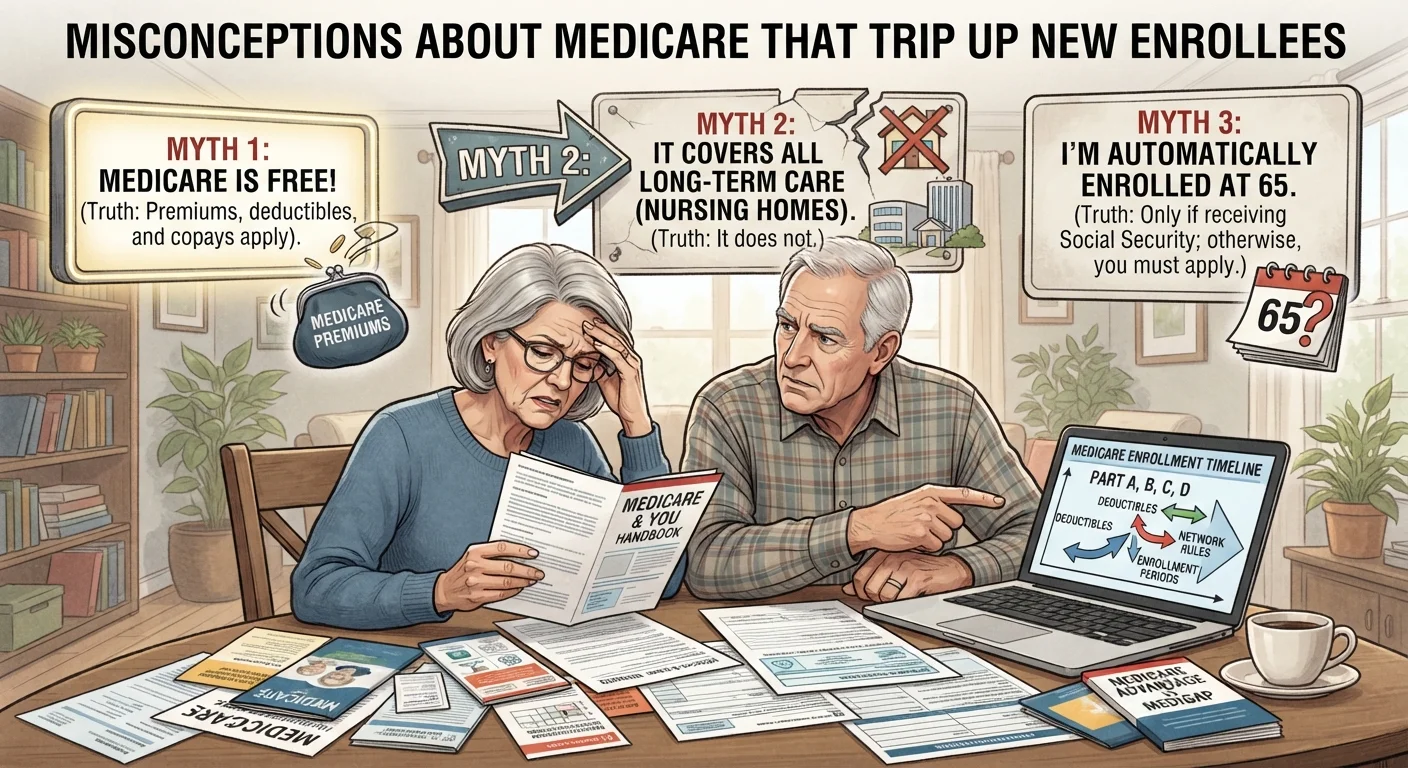
Medicare enrollment is automatic once you turn 65, so you don't need to do anything.
Fact
Automatic enrollment applies only in specific situations. Most people who are not already receiving Social Security or Railroad Retirement Board benefits must actively sign up.
If you are already collecting Social Security benefits when you turn 65, the Social Security Administration will typically enroll you in Medicare Parts A and B automatically. But if you have not yet claimed Social Security, you must enroll yourself through Social Security during your Initial Enrollment Period, which spans a seven-month window around your 65th birthday.
Missing this window without a qualifying reason can mean a gap in coverage and, in some cases, permanent premium surcharges. See how late enrollment penalties work for a full breakdown of the deadlines involved.
Myth
Medicare covers all your medical costs once you're enrolled, leaving little out of pocket.
Fact
Original Medicare (Parts A and B) covers many hospital and medical services, but it comes with deductibles, coinsurance, and no out-of-pocket maximum.
Original Medicare pays roughly 80% of approved outpatient costs after the Part B deductible. The remaining 20% has no cap, which means a serious illness or prolonged hospital stay can generate significant costs. There is also a Part A deductible for each benefit period.
To limit exposure, some enrollees purchase a Medicare Supplement (Medigap) policy. Medigap policies help cover costs that Original Medicare leaves behind, though they carry their own monthly premiums.
Myth
Medicare automatically includes prescription drug coverage.
Fact
Original Medicare does not cover most outpatient prescription drugs. To get drug coverage, you must enroll in a separate Part D plan.
Part D is a standalone prescription drug benefit offered through private insurers approved by Medicare. If you do not enroll when first eligible and go without creditable drug coverage from another source, you may face a late enrollment penalty added permanently to your Part D premium.
Creditable coverage (coverage at least as good as standard Part D) from an employer or union plan can delay this requirement without penalty, but you must document this carefully when you do eventually enroll.
Myth
Medicare covers long-term care, such as nursing home stays, for as long as you need it.
Fact
Medicare covers only short-term skilled nursing facility care under specific conditions. It does not pay for custodial care, which is help with daily activities like bathing or dressing.
Medicare Part A will pay for up to 100 days in a skilled nursing facility following a qualifying hospital stay of at least three inpatient days, but coverage diminishes after day 20, and nothing is covered after day 100. Long-term custodial care, the type most people associate with nursing homes, is not a Medicare benefit.
Medicaid may cover long-term care for those who meet income and asset requirements, but Medicare and Medicaid operate as separate programs with different eligibility rules.
Myth
If you have employer health insurance, you don't need to worry about Medicare enrollment deadlines at all.
Fact
Whether your employer coverage protects you from Medicare penalties depends on the size of your employer and whether the coverage is considered primary.
For workers at companies with 20 or more employees, employer group health plan coverage is typically primary and Medicare is secondary. In that case, you may delay Part B enrollment without penalty and have a Special Enrollment Period when you eventually leave that coverage.
At companies with fewer than 20 employees, Medicare becomes primary and the employer plan secondary. Delaying Part B in that scenario can create real coverage gaps. Veterans with VA health benefits face a different set of considerations. Veterans often have two sources of health coverage in retirement and need to understand how each applies.
Myth
Medicare Advantage and Original Medicare are basically the same thing.
Fact
Medicare Advantage (Part C) is an alternative way to receive Medicare benefits through a private insurer, with different network rules, cost structures, and benefit inclusions.
Original Medicare lets you see any provider who accepts Medicare, with no referrals required for specialists. Medicare Advantage plans typically use provider networks such as HMOs or PPOs, and care outside the network may not be covered or may cost significantly more.
Medicare Advantage plans may include benefits not found in Original Medicare, such as dental, vision, or hearing coverage, but coverage details vary widely by plan and location. Understanding how Original Medicare and Medicare Advantage are structured differently is an important step before choosing a path.
What Medicare does and does not cover
A recurring source of confusion is the scope of Medicare's benefits. The program is divided into four parts: Part A (hospital insurance), Part B (medical insurance), Part C (Medicare Advantage), and Part D (prescription drug coverage). Each part has separate costs and enrollment rules.
Services that Original Medicare generally does not cover include routine dental care, eye exams for glasses, hearing aids, and most long-term custodial care. Cosmetic procedures are also excluded. Knowing these limits in advance lets you plan for supplemental coverage before a gap becomes a financial problem.
For a deeper look at how coverage options compare, see the Senior hub for articles on Medicare, assisted living, and retirement planning basics.
Enrollment timing matters more than most people expect
Late enrollment penalties under Medicare are not temporary surcharges. The Part B penalty adds 10% to your premium for each full 12-month period you were eligible but not enrolled, and it applies for as long as you have Part B. The Part D penalty is calculated monthly and is similarly permanent.
These penalties exist because Medicare relies on a broad enrollment pool to spread risk. CMS designed the penalty structure to discourage healthy individuals from delaying enrollment until they need care. Understanding the deadlines well before your 65th birthday is the most reliable way to avoid them.
This article is for informational purposes only and does not constitute insurance, financial, or legal advice. Medicare rules are subject to change; verify current program details at medicare.gov or by contacting 1-800-MEDICARE.