
What makes an HSA different from other accounts
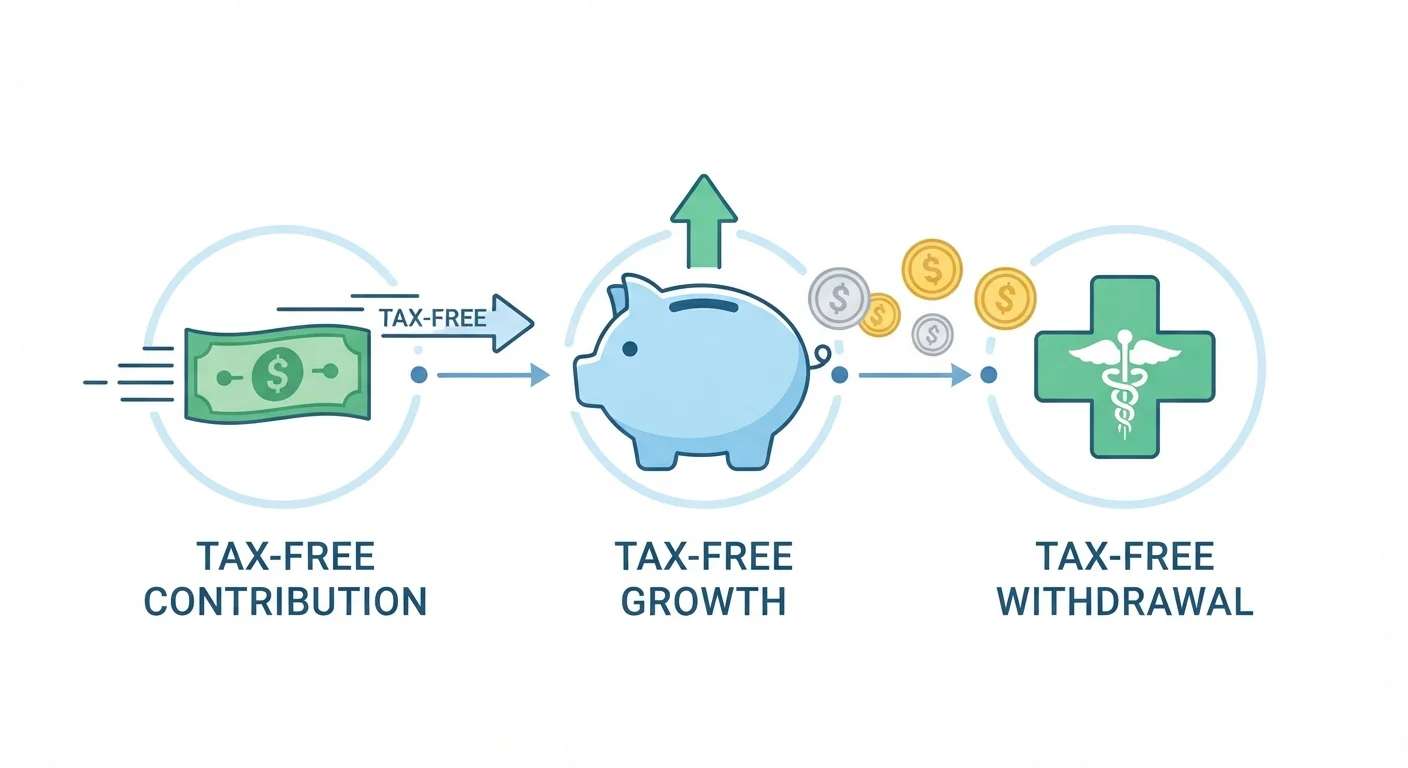
Most savings accounts serve one purpose: hold money and earn some interest. An HSA does something more specific. It shelters money from federal income tax at three stages, when you put money in, while it sits and potentially grows, and when you take it out for a medical expense.
This triple tax benefit is what separates an HSA from a standard savings account or even a Flexible Spending Account (FSA). FSAs are also tax-advantaged, but they belong to your employer, carry a use-it-or-lose-it rule for most balances, and cannot be invested. An HSA stays with you, rolls over every year, and can be invested in mutual funds or other instruments once your balance reaches a set threshold. For a broader look at how savings vehicles compare, see how checking and savings accounts work.
Because HSA money can accumulate over many years, some people treat it as a parallel retirement savings tool specifically reserved for healthcare costs in later life.
HSA eligibility: the core requirements
The IRS sets four conditions for HSA eligibility. You must:
- Be enrolled in an IRS-qualifying High-Deductible Health Plan (HDHP)
- Have no other health coverage that is not also an HDHP (with narrow exceptions for dental, vision, or specific supplemental plans)
- Not be enrolled in Medicare
- Not be claimed as a dependent on someone else's tax return
The HDHP requirement is the most consequential one. An HDHP is a plan with a minimum annual deductible and an out-of-pocket maximum that the IRS defines and adjusts each year. Not every plan with a high deductible automatically qualifies; the plan must meet the IRS thresholds. Your insurer or HR department can confirm whether your plan is HSA-eligible.
If you are new to health plan types, this plain-English overview of health insurance covers the foundational concepts before you compare options.
How HSA contributions work
Contributions can come from you, your employer, or both, but the combined total cannot exceed the IRS annual limit. Employer contributions count toward that ceiling. If your employer contributes $1,000 and the self-only limit is $4,150, you can add only $3,150 more that year.
People aged 55 or older can make a catch-up contribution on top of the standard limit. This additional amount is fixed by law rather than adjusted for inflation, but it represents a meaningful extra savings opportunity for those approaching retirement.
$4,300
2025 HSA contribution limit, self-only HDHP coverage
According to IRS Revenue Procedure 2024-25, the annual limit for self-only coverage in 2025 is $4,300.
$8,550
2025 HSA contribution limit, family HDHP coverage
The IRS set the 2025 family HDHP contribution ceiling at $8,550, per IRS Revenue Procedure 2024-25.
$1,000
Annual catch-up contribution for those aged 55 or older
The IRS allows an additional $1,000 per year for HSA holders aged 55 and older, a figure fixed by statute.
Contributions made through payroll deduction avoid both federal income tax and Social Security and Medicare taxes. Contributions made directly to your HSA (outside payroll) are deductible on your federal tax return, though the FICA tax savings apply only to payroll contributions. This distinction matters for self-employed individuals who contribute independently.
What you can spend HSA funds on
The IRS governs what counts as a qualified medical expense in Publication 502. The list is broad and includes:
- Doctor, specialist, and urgent care visits
- Prescription medications and insulin
- Dental care, including cleanings, fillings, and orthodontia
- Vision care, including exams, glasses, and contact lenses
- Mental health services and substance use treatment
- Hearing aids and batteries
- Long-term care insurance premiums (subject to age-based limits)
- COBRA continuation coverage premiums
- Medicare Parts B and D premiums and Medicare Advantage premiums (once enrolled in Medicare)
Cosmetic procedures, gym memberships in most cases, and toiletries generally do not qualify. If you spend HSA funds on a non-qualified expense before age 65, you owe income tax on the amount plus a 20% penalty. After age 65, the penalty disappears, though income tax still applies to non-medical withdrawals.
Your current plan may also include wellness perks worth using alongside your HSA. Many health plan members overlook built-in benefits such as telehealth, vision discounts, and gym access that could reduce out-of-pocket costs.
HSAs for seniors and those approaching Medicare
Once you enroll in Medicare, whether Part A or Part B, you lose the ability to contribute to an HSA. This cutoff catches some people off guard. If you delay Medicare enrollment and stay on an HDHP past age 65, contributions remain allowed. However, Medicare enrollment is automatic at 65 for people already receiving Social Security benefits, which ends HSA contribution eligibility even if you did not intend to sign up.
Existing HSA balances remain fully usable after Medicare enrollment. They cover Medicare premiums, copays, and cost-sharing tax-free, which can offset significant healthcare costs in retirement. People managing ongoing conditions may want to factor this into their plan selection. Choosing a health plan when you have ongoing medical needs covers what to weigh when your health situation involves regular care or prescriptions.
This article is for general informational purposes only and is not financial, tax, or medical advice. HSA rules are set by the IRS and are subject to change. Consult a licensed financial adviser or tax professional for guidance specific to your situation.