

Why financial vocabulary matters
Before you can compare a savings account, evaluate a loan, or read an insurance policy, you need to understand the words on the page. Financial products are built around a specific set of terms, and providers rely on that language in contracts, disclosures, and marketing materials. Readers who know these terms spend less time guessing and more time comparing what actually differs between options.
This reference covers the personal finance vocabulary that comes up most often when you are researching accounts, credit, debt, and basic investing. Each definition is written for general education, not for your specific financial situation. For decisions involving your own money, consult a licensed financial adviser or accountant.
If you plan to use these concepts as part of a broader money routine, see building a monthly money routine for practical ways to apply them consistently.
Principal
The original sum of money borrowed or deposited, before interest is applied. Loan payments reduce the principal balance over time.
Compound interest
Interest calculated on both the principal and the interest already accumulated. It accelerates growth in savings accounts and increases the total cost of debt.
APR (annual percentage rate)
The yearly cost of borrowing expressed as a percentage, including fees and interest. It allows side-by-side comparison of loan products.
APY (annual percentage yield)
The real rate of return on a deposit account after compounding over one year. A higher APY means more earned on the same balance.
Credit score
A three-digit number, typically ranging from 300 to 850, that summarizes a borrower's credit history. Lenders use it to assess risk and set interest rates.
Net worth
Total assets minus total liabilities. It measures overall financial position at a point in time, not income or spending behavior.
Liquidity
The ease with which an asset can be converted to cash. Cash and checking accounts are the most liquid; real estate and retirement accounts are less so.
Amortization
The gradual repayment of a loan through scheduled payments that cover both interest and principal. Each payment shifts the balance between the two over the loan term.
Debt-to-income ratio (DTI)
Monthly debt payments divided by gross monthly income, expressed as a percentage. Lenders use DTI to evaluate a borrower's capacity to take on additional debt.
Certificate of deposit (CD)
A time-deposit account that holds funds for a fixed period at a fixed interest rate. Early withdrawal typically triggers a financial penalty.
FDIC insurance
Federal Deposit Insurance Corporation coverage that protects depositors at member banks up to applicable limits per account category if the bank fails.
Emergency fund
A reserve of liquid savings set aside to cover unexpected expenses or loss of income without relying on credit. Financial education commonly references three to six months of living expenses as a general benchmark.
Core concepts at a glance
The quick-reference card below puts the most frequently cited data points in one place. These figures reflect general educational context and are not guarantees of what any individual will experience.
| Credit score range | 300 to 850 (FICO scale) (FICO scoring model) |
| FDIC deposit insurance limit | $250,000 per depositor, per institution, per account category (Federal Deposit Insurance Corporation) |
| Standard CD term range | 3 months to 5 years (General market range) |
| DTI threshold often cited for mortgage eligibility | 43% or below (Consumer Financial Protection Bureau general guidance) |
| Emergency fund benchmark | 3 to 6 months of living expenses (General financial education guidance) |
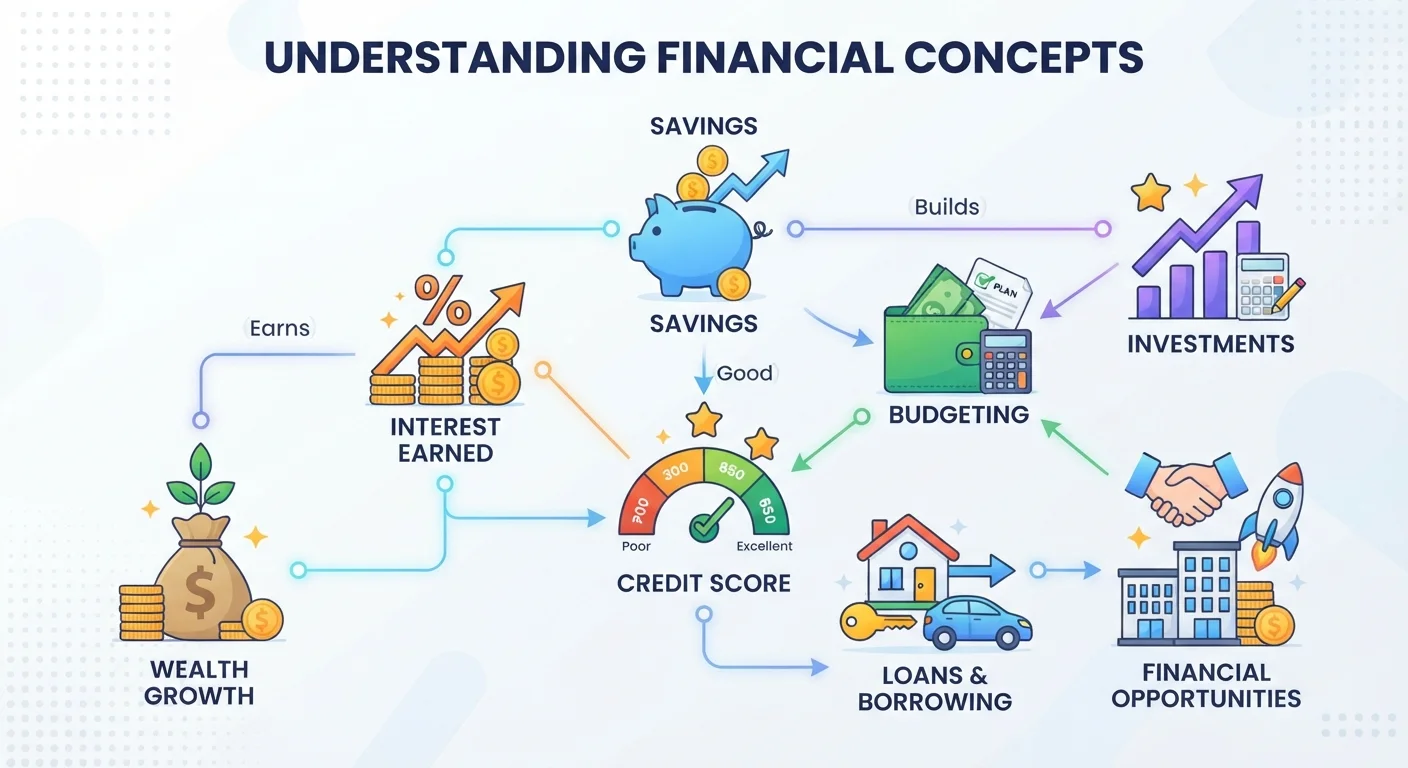
Understanding how these figures relate to each other matters. Your credit score influences the interest rate a lender offers you. That rate determines how much you pay over the life of a loan. Both affect your net worth over time. Pulling on one thread pulls the others.
For a broader picture of household costs that interact with your budget, the household utility costs reference guide covers average ranges for electricity, water, internet, and other recurring expenses across U.S. regions.
Terms that affect borrowing costs
When you borrow money, two factors determine what you actually pay back: the interest rate and how that interest compounds. Simple interest is calculated only on the principal (the original amount borrowed). Compound interest is calculated on the principal plus any interest already added to the balance. Over time, compounding makes debt grow faster and savings grow larger, depending on which side of the transaction you are on.
The annual percentage rate (APR) is a broader measure than the interest rate alone. It includes fees and other costs expressed as a yearly percentage, making it a more accurate way to compare loan offers. The annual percentage yield (APY) works similarly on the savings side, reflecting the real rate of return after compounding is applied for a year.
Amortization is the schedule by which loan payments are distributed between principal and interest over the loan term. Early payments in an amortized loan go mostly toward interest; later payments shift toward reducing the principal. Seeing an amortization schedule before signing a loan lets you understand the true cost of borrowing at any given point.
These concepts also apply when comparing auto financing options. The auto hub covers how insurance and financing terms interact for vehicle purchases.
Net worth, liquidity, and account types
Net worth is the difference between what you own (assets) and what you owe (liabilities). It is a snapshot, not a performance metric. A negative net worth is common early in adulthood when student loans or mortgages exceed accumulated assets; it typically changes as balances are paid down and savings grow.
Liquidity refers to how quickly an asset can be converted to cash without losing significant value. A checking account is highly liquid; a home is not. Keeping a portion of your money in liquid accounts matters for covering unexpected expenses without taking on new debt.
A high-yield savings account (HYSA) is a deposit account that pays a higher APY than a standard savings account, usually offered by online banks. Funds in federally insured accounts are protected up to applicable limits by the Federal Deposit Insurance Corporation (FDIC) for banks or the National Credit Union Administration (NCUA) for credit unions.
A certificate of deposit (CD) locks your money for a fixed term at a fixed rate. Withdrawing early typically incurs a penalty. CDs suit money you will not need until a known future date. If you are approaching a year-end account review, the year-end financial review checklist is a useful companion for auditing where your money sits.
This article is for general informational purposes only and does not constitute personalized financial, tax, legal, or investment advice. Consult a qualified, licensed financial professional before making decisions based on your individual circumstances.