

What each rate actually measures
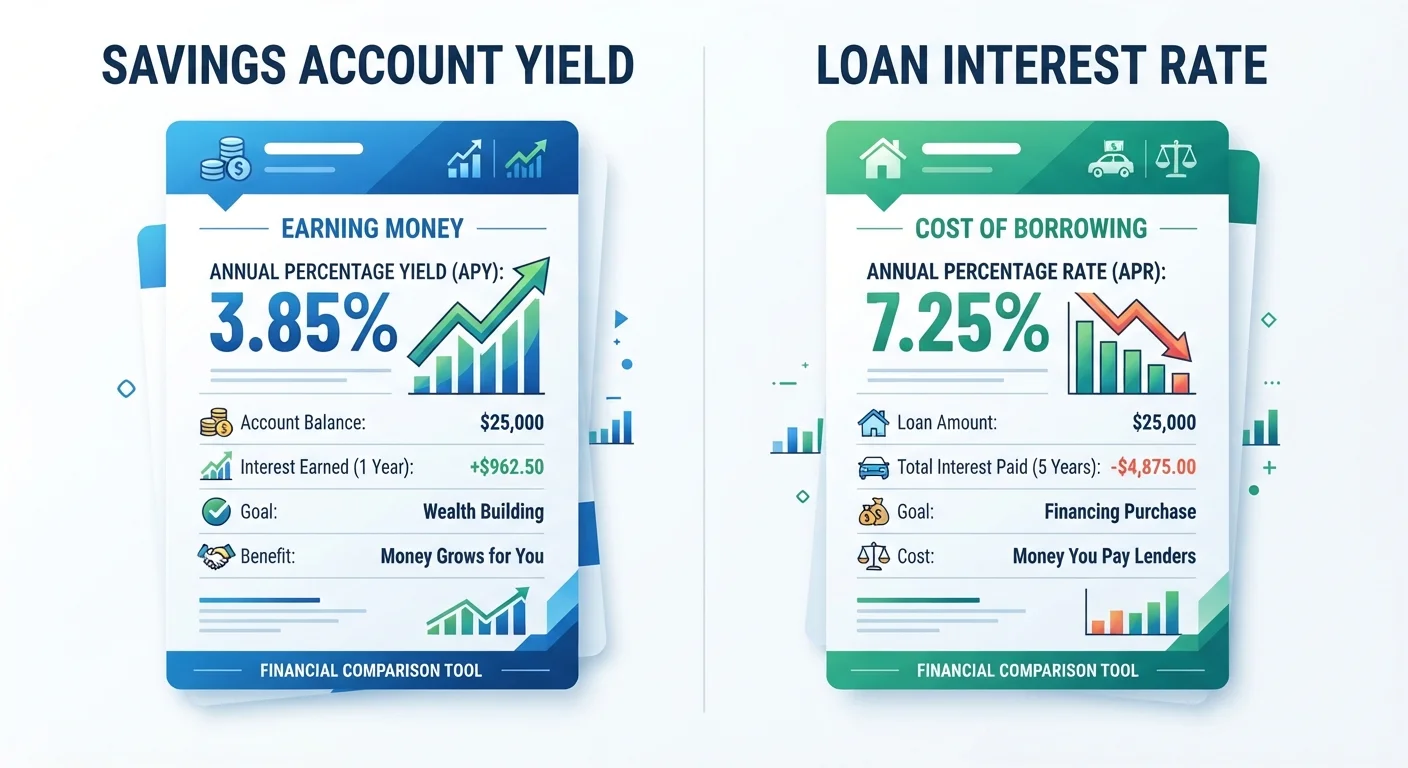
APY and APR both express interest as a yearly percentage, but they measure opposite financial directions. APY describes what happens to money you deposit. APR describes what happens to money you borrow.
When a bank quotes an APY on a savings account, it is telling you how much your balance will grow over a year once compounding is included. Compounding means the interest you earn each period gets added to your principal, and then earns its own interest in the next period. The more frequently a bank compounds (daily is common), the more your money grows compared with a flat annual rate.
APR strips compounding out of the picture. It states the annual cost of a loan as a straight percentage of the amount borrowed. For mortgages and auto loans, federal law also requires lenders to fold certain fees into the APR calculation, which is why the APR on those products is often slightly higher than the advertised interest rate.
Why compounding changes the math
The gap between a nominal interest rate and APY grows with compounding frequency. A savings account with a 5% nominal rate that compounds monthly produces an APY of roughly 5.12%. The same rate compounding daily produces an APY of about 5.13%. Those fractions add up on large balances over time.
For borrowers, the reverse logic applies. Credit card issuers typically compound interest daily on unpaid balances. This means carrying a balance from month to month costs more than the stated APR alone suggests. The effective annual cost of a revolving credit card balance is higher than its APR, even though APR is the figure most prominently disclosed.
365x
How often many credit cards compound interest
Most major credit card issuers apply a daily periodic rate to unpaid balances, compounding interest every day the balance is not paid in full.
~0.13%
APY gain from daily vs. annual compounding at 5%
A 5.00% nominal rate compounding annually yields a 5.00% APY; the same rate compounding daily yields approximately 5.13% APY, illustrating how frequency affects real earnings.
How to use each rate when comparing products
When comparing high-yield savings accounts, use APY as the primary figure. It is the only rate that accounts for compounding frequency, so it lets you compare accounts that compound at different intervals on a level basis. A slightly lower nominal rate with more frequent compounding can produce a higher APY than a higher nominal rate that compounds annually.
When comparing loans, credit cards, or lines of credit, focus on APR. For installment loans such as mortgages, the APR typically includes origination fees and other lender charges spread across the loan term, making it a more complete cost figure than the interest rate alone.
One practical note: APR does not tell you the total dollar cost of a loan, because that also depends on how long you borrow the money. Two loans with the same APR can have very different total interest costs if their repayment terms differ. Use APR to compare the rate, then calculate total interest to compare the full cost.
Checking and savings accounts both appear on deposit disclosures, but checking accounts often pay little or no interest, making APY less relevant there than it is for savings and money market accounts.
A common place these get confused
Credit cards show an APR, but the daily compounding of unpaid balances means the actual yearly cost of carrying debt is higher than that figure. Some issuers separately disclose a daily periodic rate (the APR divided by 365), which reflects how interest accrues each day on the outstanding balance.
Savings account advertisements sometimes display a promotional rate prominently alongside the APY in smaller print. Reading only the promotional rate and assuming it equals the APY is a common error. The APY is the figure that tells you what a deposit will actually earn over a full year under current compounding terms.
This article is for general informational purposes only and is not personalized financial advice. Consult a licensed financial professional for guidance specific to your situation.